

 en
en
 English
 Español
At a district heating substation, a control signal sends a 4–20 mA command, and within seconds a butterfly valve swings open, redirecting hot water to another zone. A few meters away, an operator closes a smaller valve by turning a handwheel through a gearbox. Both operations are carried out by actuators, and both illustrate the same principle: energy is converted into controlled mechanical motion.
In simple terms, an actuator is a device that moves or holds a mechanism on command. So what does an actuator do exactly? It converts electrical, pneumatic, hydraulic, or manual energy into force, torque, and displacement, with the repeatability and timing that automated systems depend on.
Quick answer: An actuator converts energy — electrical, pneumatic, hydraulic, or human — into predictable linear or rotary motion to open, close, adjust, or hold a mechanism.
Content
- 1 What Does an Actuator Do?
- 2 How Does an Actuator Work?
- 3 Main Types of Actuators
- 4 Quarter-Turn Actuators in Valve Automation
- 5 How to Choose the Right Actuator
- 6 Frequently Asked Questions
- 6.1 Q1. What does an actuator do in simple terms?
- 6.2 Q2. What is the difference between an actuator and a motor?
- 6.3 Q3. What is a quarter-turn actuator used for?
- 6.4 Q4. How do I choose between pneumatic and electric actuators?
- 6.5 Q5. How do I size an actuator for my valve?
- 6.6 Q6. What does fail-safe mean on an actuator?
What Does an Actuator Do?
The defining job of an actuator is to produce controlled output motion. That output can take three basic forms:
- Linear motion — extending or retracting a rod to push, pull, lift, or clamp.
- Rotary motion — rotating a shaft through a defined arc, often 90 degrees for quarter-turn valves.
- Holding action — maintaining a position or torque against a load without continuous movement.
Actuators appear wherever a machine must be controlled from a distance, sequenced precisely, or moved faster or harder than a person can. Common examples include butterfly valves in pipelines, dampers in HVAC systems, clamping fixtures on machining lines, and positioning drives in packaging equipment. In each case, the same question applies: what does an actuator do for this system? It translates a small control signal into a strong, reliable mechanical action.
How Does an Actuator Work?
Every actuator follows the same working logic: an energy input drives a transmission, and the transmission shapes that energy into the desired output motion. The transmission determines the force, torque, speed, stroke, and direction that matter for the application.
In an electric actuator, a motor produces continuous rotation. A gearbox reduces the speed and multiplies torque, then a lead screw, rack, or crank converts rotation into linear motion where needed. In a pneumatic actuator, compressed air pushes a piston inside a cylinder; the piston carries a rack, and the rack turns a pinion on the output shaft, which mounts directly to the valve stem. Hydraulic actuators use the same principle with pressurized oil, giving much higher force density in a compact package.
Manual actuators replace the motor with human effort. A handwheel and a reduction gearbox multiply the operator's input torque, so one person can comfortably operate a valve that needs a thousand newton-metres or more. Gear reduction appears in nearly every industrial valve installation for the same reason: power in, torque out.
Figure 1. Isometric cutaway of a pneumatic rack-and-pinion actuator mounted on a butterfly valve.
Main Types of Actuators
Selecting the right family starts with understanding the differences in energy source, output characteristics, control precision, and maintenance. The table below compares the four types most commonly used in valve and industrial automation.
| Type | Energy source | Typical output | Control precision | Maintenance | Best suited for |
|---|---|---|---|---|---|
| Electric | Electric motor | Linear or rotary | High | Low | Precise positioning, multi-turn valves, IoT-ready plants |
| Pneumatic | Compressed air | Quarter-turn or linear | Medium | Moderate | Fast on/off, harsh areas, explosion-risk zones |
| Hydraulic | Pressurized oil | High-force linear or rotary | Medium-high | High | Very large forces, continuous heavy duty |
| Manual / mechanical | Human effort | Rotary via gearbox | Operator-dependent | Low | Backup operation, low-cost OEM installations |
Figure 2. Typical quarter-turn output torque ranges, log scale; ranges differ between product families.
Quarter-Turn Actuators in Valve Automation
A quarter-turn (or part-turn) actuator rotates its output shaft through about 90 degrees, which is exactly what butterfly, ball, and plug valves need. Because the valve element moves from fully open to fully closed with a single quarter turn, these actuators are compact, fast, and economical compared with multi-turn operators.
For automated on/off service, the pneumatic rack-and-pinion actuator is the workhorse of process plants. Compressed air provides rapid operation, spring-return cartridges provide fail-safe closure, and the mechanism tolerates vibration, temperature swings, and wash-down environments. When plant air is unavailable or modulating control is required, electric quarter-turn actuators are preferred for their programmable positioners, feedback signals, and data logging.
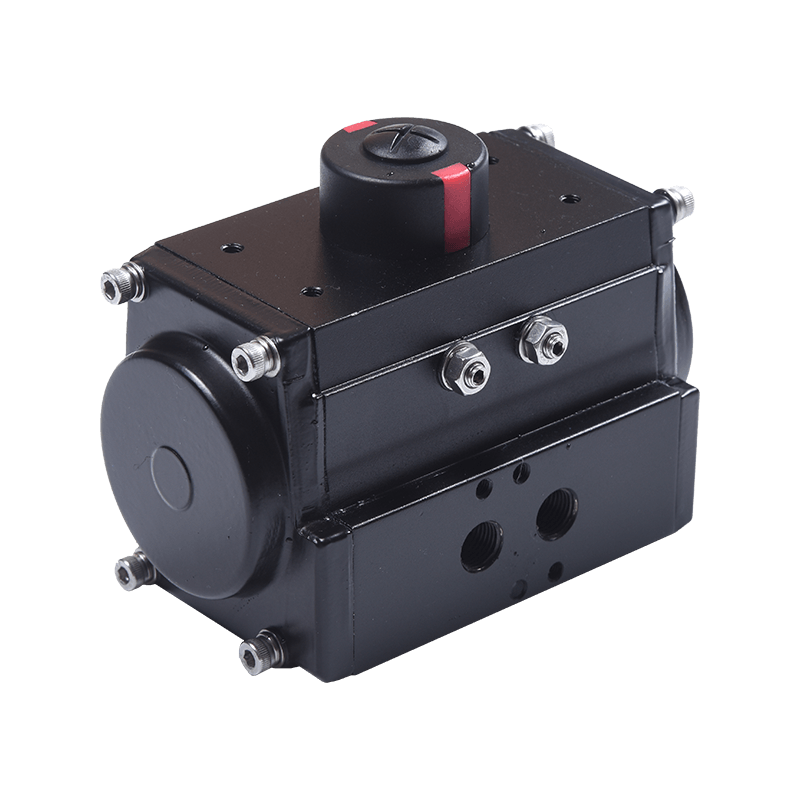 Hawks 10 Series Dual-Piston Rack-and-Pinion Pneumatic ActuatorThis actuator offers fast quarter-turn operation with spring-return fail-safe options, suited for automated on/off service. Its aluminum body, low-friction bearings, and ISO5211 mounting make it a reliable choice for plant environments.View Product →
Manual part-turn gearboxes remain essential for large valves and as a backup for automated ones. A handwheel rotated through a reduction gear produces high output torque at the valve stem, letting one operator move a valve that would otherwise require a lever several metres long. Sizing is straightforward: take the valve operating torque, divide by the gear ratio, and check the handwheel effort at the required speed.
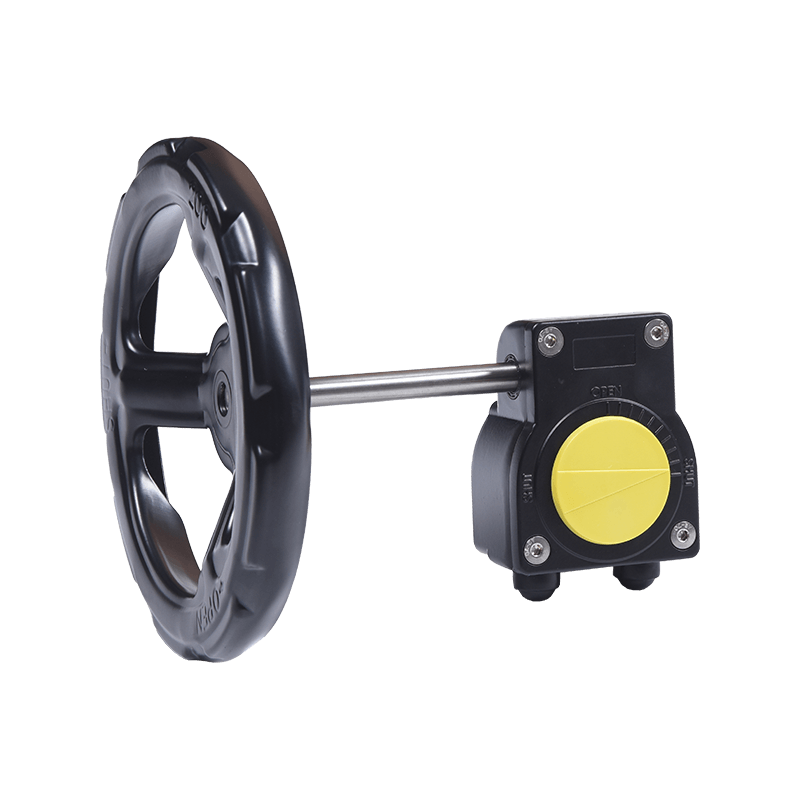 20-Series Manual Aluminum Part-Turn Gearbox for Quarter-Turn ValvesDesigned for manual operation of butterfly, ball, and plug valves, this gearbox provides output torque from 180 to 5500 N·m. Its weatherproof IP65 rating and ISO5211 mount simplify installation on large or backup valve applications.View Product →
Figure 3. Torque demand is not constant across the stroke — sizing from a single average causes problems.
The torque profile shows why actuator sizing should never be a guess. A typical butterfly valve reaches its maximum dynamic torque near 75–80° of disc opening, while seat and bearing friction dominates in the closed position. Selecting an actuator from mid-stroke averages alone is a common cause of stiction, undersized operators, and premature wear. Use the valve manufacturer's published torque at maximum differential pressure, then add a safety margin of 25–30%.
In plants where availability matters, a declutchable gearbox between the pneumatic actuator and the valve allows automatic operation during normal service and manual handwheel operation when air is lost or during commissioning. This dual-mode arrangement avoids duplicating equipment while keeping the process controllable in an emergency.
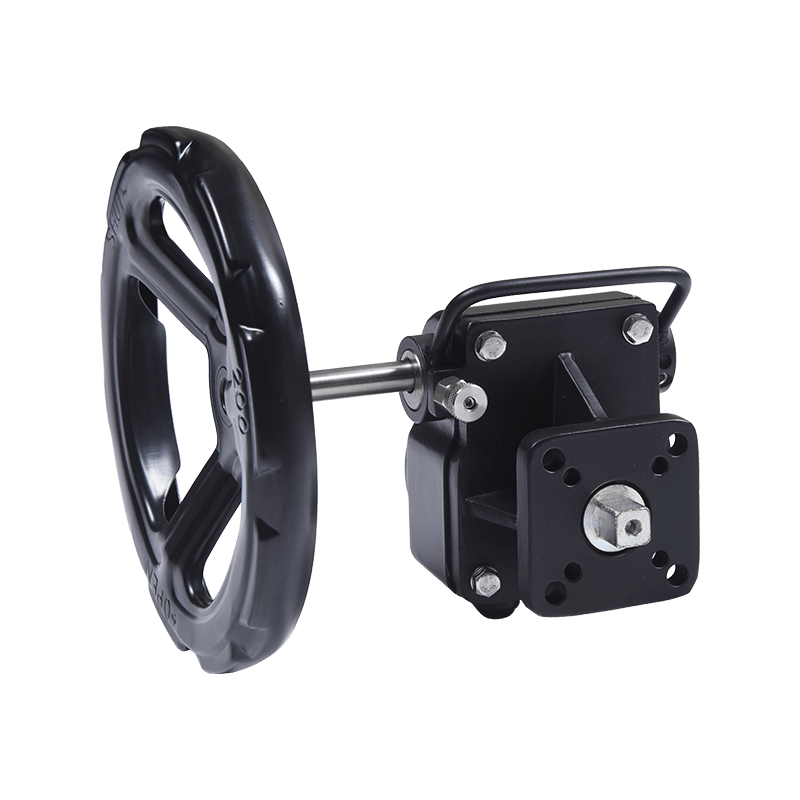 GD-Series Aluminum Declutchable Gearbox with Manual OverrideThis declutchable gearbox mounts directly on rack-and-pinion pneumatic actuators, enabling manual handwheel operation when air is unavailable or during commissioning. It supports ISO5211 connections and covers 180 to 5500 N·m output torque.View Product →
For a deeper look at the internal mechanics, read what a part-turn gearbox is and how it works.
How to Choose the Right Actuator
Whether you are specifying a single replacement or building actuators into a product line, work through the same checklist:
- Required torque — use the valve manufacturer's torque at maximum differential pressure, then add 25–30% safety margin.
- Control type — on/off or modulating; analog (4–20 mA, 0–10 V) or digital bus.
- Power source — compressed air infrastructure, 24 V DC, 230 V AC, or manual effort.
- Duty cycle — occasional operation versus continuous modulation changes the operating temperature and life.
- Fail-safe position — spring return, stored air, or lock-in-place determines behaviour on power loss.
- Environmental rating — IP protection, ambient temperature, corrosive wash-down, or hazardous area classification.
- Manual override — handwheel or declutch mechanism for commissioning and emergencies.
For OEM manufacturers, actuator selection is also a supply-chain decision. Flange patterns, stem connections, and torque ratings must match between valve and actuator; small interface mismatches create leaks, stem wear, and early failures. Working with a vertically integrated manufacturer that casts, machines, and assembles operator components under one roof shortens lead times and keeps the interface consistent from drawing to delivery.
Frequently Asked Questions
Q1. What does an actuator do in simple terms?
It converts energy into movement. In a valve system, it opens, closes, or modulates the valve automatically or from a remote signal.
Q2. What is the difference between an actuator and a motor?
A motor produces continuous rotation; an actuator includes the transmission and control elements that produce precise, repeatable linear or rotary motion for a specific task.
Q3. What is a quarter-turn actuator used for?
It rotates an output shaft 90 degrees to operate butterfly, ball, and plug valves in water treatment, HVAC, and process piping.
Q4. How do I choose between pneumatic and electric actuators?
Choose pneumatic for fast on/off in harsh or explosive zones; choose electric for precise modulation, energy efficiency, and plants without compressed air.
Q5. How do I size an actuator for my valve?
Use the valve's operating torque at maximum differential pressure, apply a 25–30% safety factor, and match the actuator output torque and travel time.
Q6. What does fail-safe mean on an actuator?
It means the valve moves to a defined position — normally open or normally closed — when power or air is lost, usually through a spring return or stored energy.